Deployment readiness

Start with the right view of the inspection.

A strong line inspection begins by making the defect or condition consistently visible. United Vision helps plant teams qualify the camera view, optics, lighting, presentation, timing, factory-owned edge device, interfaces and production response before model development starts. Production inference always runs at the edge.

In brief

An existing factory camera can support AI visual inspection when it captures the required condition clearly and consistently, exposes usable images at production speed and connects to a supported edge environment. United Vision evaluates the complete image and decision path so plants can reuse suitable equipment and replace only what the inspection requires.

Your camerasBring qualified cameras already in the plant or choose supported new ones.
Your edgeUse a supported factory-owned edge device. Production inference always runs here.
Your preferred cloudRun United Vision cloud services in a supported account chosen and owned by your company.
One factory. One price.Add unlimited use cases within the licensed factory.

Readiness framework

Ten questions that move an inspection toward production.

01

Inspection decision

What exact condition must be recognized, and what happens next?

A visual inspection is ready to scope when the plant can describe the condition in observable terms, separate acceptable from unacceptable examples, and agree what should follow a verdict: record, alert, review, route or reject. That definition anchors image collection, model labels, validation criteria and the production response.
02

Field of view

Can the target region be seen consistently at the required detail?

The camera view must show the smallest relevant feature clearly across normal product positions and operating variation. Collect representative images at production speed and check resolution, framing and repeatability. If operators or reviewers cannot see the condition reliably in those images, the inspection is not ready for model training.

03

Optics and lighting

Do focus, depth, exposure, contrast and glare remain controlled?

Lighting and optics are ready when the defect remains visible despite expected shifts in ambient light, surface reflectivity, product color and distance. Lock the lens, exposure and light geometry, then test them across normal production. Stable image evidence matters more than simply adding a higher-resolution camera.

04

Part presentation

Are orientation, speed, vibration and occlusion understood?

Map how every part enters the view, including rotation, vibration, spacing, speed and anything that can hide the target. The setup is ready when acceptable presentation limits are defined and the line can keep parts inside them, or the capture design can reliably accommodate the variation.

05

Image source

Can the camera provide reliable images and timing to the processing path?

A camera is suitable when it can deliver usable images at the required resolution and cadence, expose reliable capture timing, and connect through a supported path to processing. Existing cameras can be reused when they meet those conditions; compatibility and image access still need to be confirmed for the specific line.

06

Edge environment

Is compute, network, power and environmental protection appropriate?

The supported factory-owned edge device must provide enough capacity for the inspection, stable power and networking, suitable mounting and protection, and a maintainable update path. Production inference always runs on this edge device, so qualification measures the complete camera-to-verdict latency under real line conditions.

07

Interfaces

How will the workflow receive triggers and return events or results?

Document what starts image capture, what the inspection returns, where results go and how the line behaves when an input, device or connection fails. Review that signal and response map with plant controls and operations teams. United Vision does not require one proprietary hardware stack, but each interface must be qualified.

08

Response time

What latency is acceptable for alerting, routing or process action?

Set the maximum time from image capture to the required production action by working backward from line speed, physical distance and the response mechanism. United Vision supports sub-50ms verdicts, while total response time also includes capture, communication and downstream equipment. Validate the complete path under production conditions.

09

Validation

Which test set, thresholds and sign-offs govern release?

Build a representative validation set that covers acceptable product, known defects, normal process variation and challenging conditions across shifts or variants. Agree thresholds, review rules and approval owners before release. Validation should measure the inspection decision that matters on the line, not only a model score in isolation.

10

Change control

What production changes trigger review or requalification?

Define which changes require review: product or packaging variants, new defect definitions, camera movement, lens or lighting adjustments, line-speed changes, software or edge changes, and unusual performance drift. Assign an owner to assess, retrain and revalidate through the plant-controlled lifecycle before the updated inspection returns to production.

Existing cameras

Turn an existing camera into a qualified inspection view.

Reuse supported equipment when it fits the decision

“We already have a camera” is the beginning of the assessment.

The relevant question is whether the complete image path can produce consistent evidence at the speed and precision the decision requires.

  • Resolution and feature size
  • Lens, focus and depth of field
  • Lighting geometry and exposure
  • Mounting stability and line motion
  • Triggering, interfaces and image access
  • Edge compute and environmental constraints
Read the camera-readiness guide
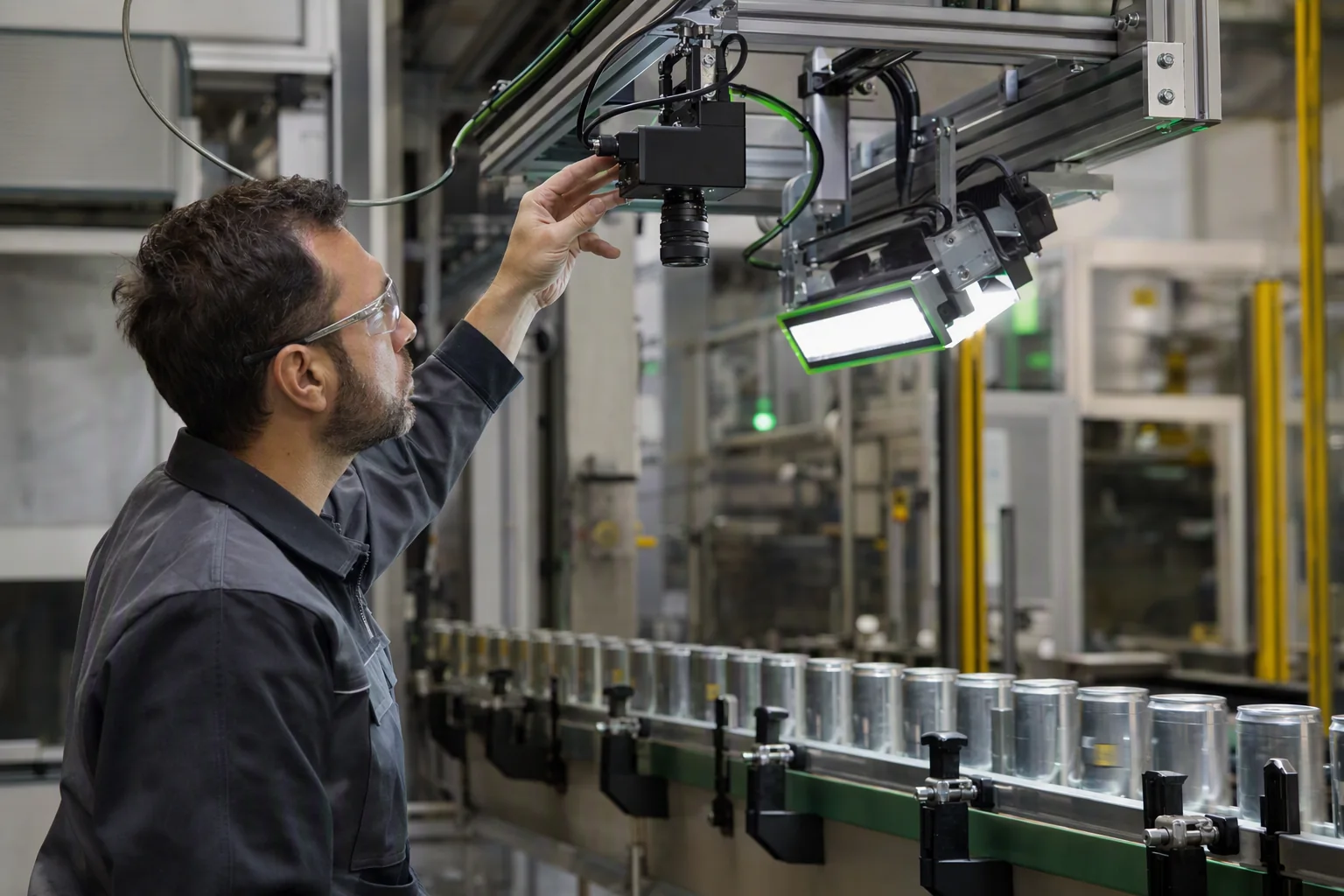
Industrial camera and lighting evaluated on a production line

Questions answered

What buyers ask about deployment readiness.

Can United Vision use CCTV cameras?

A general-purpose camera may be useful for exploration, but production inspection depends on image detail, consistency, timing, access and environmental fit. It must be evaluated against the decision.

Does edge deployment mean the system works offline?

Edge inference can reduce latency and dependence on continuous cloud connectivity, but the exact architecture, administration and update path must be defined for the environment.

Do you supply cameras and lighting?

The deployment model should begin with the inspection requirement. Supported existing hardware or fit-for-purpose components can then be qualified without assuming one proprietary stack.

Where do inference and the United Vision cloud instance run?

Production inference always runs on a supported factory-owned edge device. United Vision cloud services run in a supported cloud account chosen and owned by the customer. The readiness review qualifies both environments and the controlled path between them.

Bring one inspection opportunity. Leave with a clearer path.

A working session is designed around the image source, operating condition, decision, response and ownership model, not a generic product tour.

Book a working session